

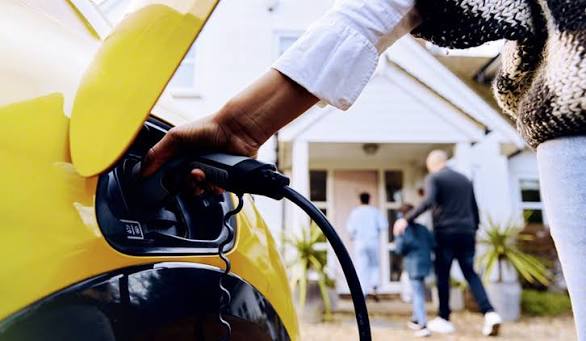
An EV charger can use anywhere from a few kilowatt-hours to several dozen kilowatt-hours of electricity per charging session, depending on how much energy your vehicle needs. For example, if your EV requires 30 kWh to replace the energy used during your driving, the charger will draw roughly that amount from your home’s electrical system, plus some additional energy lost during charging. At an electricity rate of $0.15 per kWh, 30 kWh would cost about $4.50.
The exact amount depends on your vehicle’s battery size, driving distance, charging level, charging efficiency, and local electricity rate. For homeowners considering an EV, understanding these factors makes it easier to estimate both monthly electricity consumption and charging costs.
How EV Charging Electricity Use Is Measured
Electricity consumption is measured in kilowatt-hours, or kWh. This is the same unit that appears on a household electricity bill.
A charger rated at 7.2 kilowatts, for example, could theoretically deliver 7.2 kWh of electricity during one hour of operation. Running it for two hours would use approximately 14.4 kWh.
Actual consumption can be slightly higher because some energy is lost as heat and through the vehicle’s charging equipment.
How Much Electricity Does a Typical EV Need?
EV batteries vary considerably in size. Smaller vehicles may have batteries around 40 kWh, while larger electric SUVs and trucks can have batteries exceeding 100 kWh.
However, drivers rarely recharge an entire battery from empty to full every day.
Suppose an EV has a 75 kWh battery and the driver uses 25% of its capacity during a typical day. Replacing that energy would require approximately 18.75 kWh under ideal conditions.
The amount of electricity used for charging is therefore more closely connected to how much you drive than simply the size of your battery.
How Many kWh Does an EV Use Per Mile?
Another useful way to estimate electricity consumption is to look at how much energy an EV uses to travel a specific distance.
Many EVs consume roughly 25 to 35 kWh per 100 miles, although efficiency varies by model.
For example, an EV that averages 30 kWh per 100 miles uses approximately 0.30 kWh per mile. A driver traveling 30 miles would therefore use around 9 kWh for that trip.
Over a month, someone driving 1,000 miles in the same vehicle could require roughly 300 kWh of energy before accounting for charging losses.
Does a Level 1 Charger Use Less Electricity?
Level 1 chargers typically connect to a standard household outlet and charge an EV relatively slowly.
Although Level 1 equipment operates at a lower power level, it does not necessarily mean the vehicle requires less total electricity.
If the battery needs 20 kWh, approximately 20 kWh still needs to be supplied regardless of whether the energy comes from Level 1 or Level 2 charging. The primary difference is how quickly that electricity is delivered.
Level 1 charging may be sufficient for drivers with short daily commutes, while people who drive longer distances may prefer faster charging.
How Much Electricity Does a Level 2 Charger Use?
Level 2 chargers operate at a higher voltage and can provide substantially faster charging than Level 1 equipment.
The exact power draw depends on the charger, circuit, and vehicle. A charger operating at approximately 7.2 kW for two hours, for example, would consume around 14.4 kWh.
Using the same charger for four hours would consume approximately 28.8 kWh.
The vehicle may also adjust its charging rate as the battery becomes fuller, so charging does not always occur at the maximum advertised rate for the entire session.
How Much Does It Cost to Charge an EV at Home?
The basic calculation is simple:
Electricity used × electricity price = charging cost
For example, if an EV requires 30 kWh and electricity costs $0.15 per kWh, the energy cost would be approximately $4.50.
Your actual bill may differ because utility rates can include additional charges, taxes, delivery fees, and other costs.
Some utility companies also offer time-of-use pricing, where electricity costs less during certain hours. If that option is available, charging overnight or during off-peak periods may reduce the cost.
Will an EV Charger Increase Your Electricity Bill?
Yes. Charging an EV at home adds electrical consumption to the household, but the increase depends largely on how much you drive.
A homeowner using 200 kWh per month for EV charging will naturally add less electricity consumption than someone using 400 kWh.
For example, at $0.15 per kWh, 200 kWh would represent approximately $30 in energy costs, while 400 kWh would represent approximately $60.
These figures are examples rather than universal charging costs because electricity prices differ between locations and utility providers.
Can an EV Charger Overload a Home Electrical Panel?
A Level 2 EV charger can represent a significant electrical load. Before installation, homeowners should consider the capacity of their existing electrical panel and the other major appliances operating in the home.
Older properties may have limited electrical capacity or outdated components that need attention before a new charging circuit is added.
A professional electrical contractor such as Edison Electric Inc can evaluate the home’s electrical system and determine whether it can accommodate the additional load.
Why Professional EV Charger Installation Matters
Installing an EV charger involves more than simply connecting equipment to an electrical supply.
The installation may require a dedicated circuit, appropriately sized wiring, a suitable breaker, and proper placement of the charging equipment. The electrical system also needs to be evaluated to make sure the additional load can be handled safely.
Professional EV charging station installation can help homeowners select an appropriate setup based on the vehicle, charger, and home’s electrical infrastructure.
This is particularly important when installing a higher-powered Level 2 charger.
What Factors Increase EV Electricity Consumption?
Several factors can cause an EV to use more electricity than expected.
Cold temperatures can reduce battery efficiency, while heating the vehicle’s interior can consume additional energy. Highway driving at higher speeds, rapid acceleration, hills, heavy cargo, and towing can also increase consumption.
Tire pressure and driving habits matter as well.
On the other hand, moderate speeds, efficient driving, regenerative braking, and properly maintained tires can help reduce energy use.
Because of these variables, two people driving similar EVs may have noticeably different monthly electricity consumption.
How to Estimate Your Monthly Charging Needs
The easiest approach is to start with your average monthly mileage.
Suppose you drive 1,000 miles per month and your vehicle averages 0.30 kWh per mile.
1,000 miles × 0.30 kWh = approximately 300 kWh
That gives you a basic estimate of the energy required for driving. You can then multiply the estimated kWh by your local electricity rate to estimate the energy portion of your monthly charging cost.
Remember that electricity drawn from the home will generally be somewhat higher because charging is not 100% efficient.
An EV charger can use anywhere from a relatively small amount of electricity for short daily driving to several hundred kWh per month for drivers who travel longer distances.
The most important factors are how far you drive, how efficient your vehicle is, how much energy you need to replace, and what your utility charges per kWh.
For homeowners considering an EV charger, electricity consumption is only one part of the decision. The home’s electrical capacity, charger type, circuit requirements, and installation location should also be considered.
Understanding these factors ahead of time can make it easier to estimate charging costs and choose a setup that fits both your vehicle and your home’s electrical system.